- Letters: B/ADEGHN
- Words: 42
- Points: 228
- Pangrams: 2
|
The table provides clues for the roots of words in today's NY Times Spelling Bee. You're responsible for prefixes, suffixes,
tense changes, plurals, doubling consonants before suffixes, and alternate spellings of roots. An exception:
since Sam won't allow S, when the root contains an S, the clue may be for a plural or suffixed form. "Mice" for example.
If a clue isn't self-explanatory, try googling it. And if AI tries to be too helpful, try prefixing your search with "word for" or "word meaning".
The TL;DR about the site comes after the table.
Past clues are available here |
Today's puzzle
| |
|
Table content
|
| answers covered | answer's first two letters | answer's length | clue for root (answer may need prefix, suffix, tense change, alt spelling, ...) |
|---|---|---|---|
| 1 | AB | 4 | Poetic for “in the sack” (sleeping), adv. |
| 1 | BA | 5 | Sound a sheep makes, noun/verb |
| 1 | BA | 4 | Rum sponge cake, or Ali & his 40 thieves |
| 1 | BA | 4 | Infant, slugger Ruth, or pig film |
| 1 | BA | 4 | (Archaic) past tense verb of making an auction offer or saying farewell or adieu |
| 2 | BA | 5,6 | Emblem worn as a mark of office, membership, or employment, noun/verb |
| 1 | BA | 6 | Container made of flexible material with an opening at the top, used for carrying things, noun/verb |
| 1 | BA | 7 | Items packed in a suitcase & checked before flying |
| 1 | BA | 6 | Prohibit, verb |
| 1 | BA | 6 | Common yellow plantain variety |
| 2 | BA | 4,6 | Musical group, noun; or loop (as in “wedding” & “arm”), noun; or form a group, verb (… together) |
| 2 | BA | 7,8 | Strip of material used to protect a wound or injured part of the body, noun/verb |
| 2 | BA | 7,8 | Mask or headscarf, 2 spellings |
| 1 | BA | 4 | Cause of annoyance, or DC Comics villain (he’s the … of my existence) |
| 2 | BA | 4,6 | Sound of a collision, noun (“The Big … Theory”) |
| 2 | BE | 4,6 | Drop of sweat, or small decorative object (for a necklace, e.g.) |
| 2 | BE | 4,6 | Legume (lima …), noun; or hit on the head, verb |
| 1 | BE | 7 | Soft, flexible fabric or plastic sack, filled with beads or similar small objects. Small ones can be tossed. Large ones can be sat on. Compound. |
| 1 | BE | 6 | Furniture you sleep on, noun/verb |
| 1 | BE | 7 | What your hair looks like if you don't comb it when you get up in the morning, compound slang |
| 1 | BE | 4 | Past participle of “to exist” (“How have you … doing?”) |
| 1 | BE | 6 | Plead |
| 1 | BE | 5 | Start, verb (also former Israeli PM) |
| 1 | BE | 4 | Shape into a curve, or Oregon city |
| 2 | BE | 6,8 | Body part that holds your brain, eyes, ears, nose and mouth |
| 1 | DA | 6 | Press lightly with a piece of absorbent material in order to clean or dry something, verb; or a small amount of something, noun (Brylcreem's "A little …'ll do ya!") |
| 1 | EB | 5 | Recede, especially in reference to the tide |
| 1 | GA | 6 | Talk at length, typically about trivial matters |
| 1 | HA | 7 | Purse, compound |
| 1 | HE | 8 | Fabric strip, usually made of flexible fabric, that wraps around your noggin and keeps sweat out of your eyes, compound |
| 2 | HE | 8,10 | Shake or nod your noggin up and down with great force and speed in time with the heavy beat of loud music, compound pangram verb. Its past tense is also a pangram. |
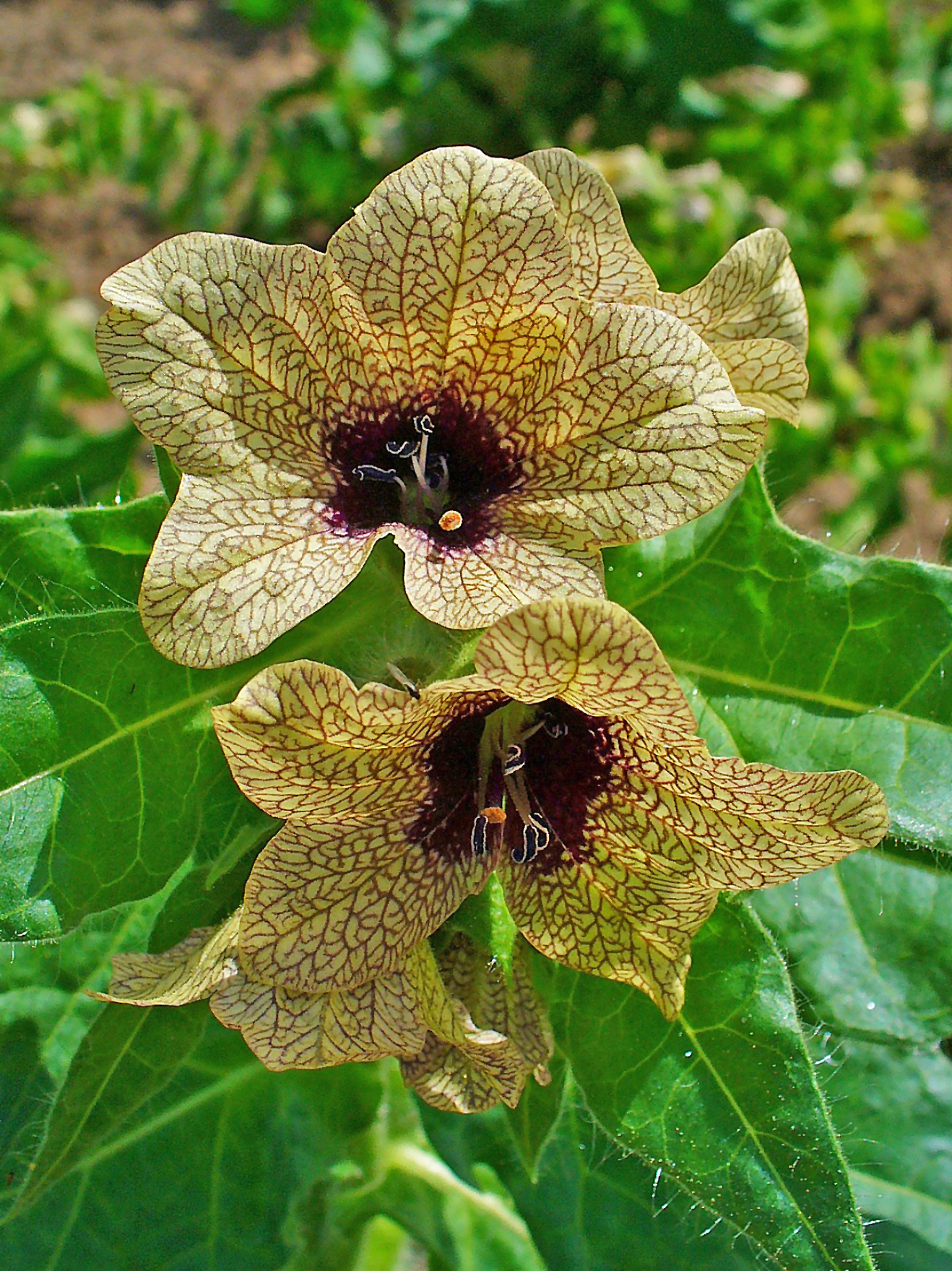
| 1 | HE | 7 | Foul-smelling, highly poisonous plant in the nightshade family, featuring sticky, hairy leaves, and yellowish-brown flowers with purple veins (Hyoscyamus niger). Contains scopolamine and other strong alkaloids. Compound. |
| 1 | NA | 6 | Take, grab, or steal something; catch someone doing something wrong |
This site provides clues for a day's New York Times Spelling Bee puzzle. It follows in Kevin Davis' footsteps. The original set of 4,500 clues came from him, and they still make up about three quarters of the current clue set.
The "Bee Roots" approach is to provide explicit clues for root words, not every word. As logophiles, we are pretty good at putting on prefixes and suffixes, changing tense, and forming plurals (including Latin plurals!). The clues cover root words, arranged alphabetically by root word, with a count of words in the puzzle that come from each root. For example, if a puzzle includes ROAM and ROAMING, there will be a clue for ROAM and a count of 2. The root may not appear in the puzzle at all; for example, the 2021-07-23 Bee included ICED, DEICE, and DEICED. For such a puzzle, the clue would be for ICE with a word count of 3.
The Bee Roots approach involves judgement sometimes. For example, if a puzzle includes LOVE, LOVED, and LOVELY, how many roots are needed to cover them? LOVE and LOVED share the root LOVE, certainly, but LOVELY is tricky. LOVE is part of its etymology, but by now, the word means "exquisitely beautiful," which is a lot farther from the meaning of LOVE than swithcing to past tense. I'm inclined to treat LOVE and LOVELY as separate roots. You may not agree, which is fine. Another thing we logophiles share is a LOVE of arguing about words on social media.
A few words can have one meaning as a suffixed form and another as a stand-alone word. EVENING, for example. In those cases I will use the meaning that I think is more common.
One last complication, until another one pops up: a few roots have multiple spellings, for example LOLLYGAG and LALLYGAG. Depending on the day's letters, and maybe even the editor's whims, one or both could be in the puzzle's answer list. With such roots, you could see a word count of 2, even if there are no applicable prefixes or suffixes.
I will do my best to keep this site up to date and helpful (I hope). Check it out, and tweet feedback to @donswartwout Tweet to @donswartwout